
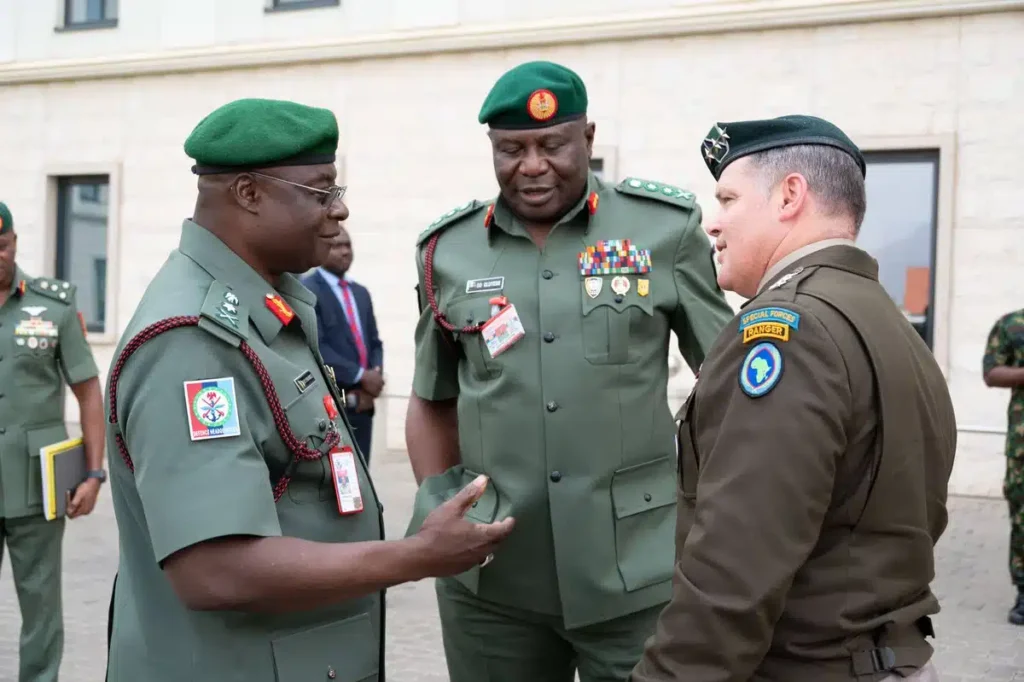
The United States has stepped up its supply of military equipment and intelligence support to Nigeria as part of a wider effort to counter Islamic State–linked militant groups across Africa.
The Deputy Commander of the US Africa Command, Lt.-Gen. John Brennan, revealed this during an interview with AFP following a US–Nigeria security meeting held in Abuja last week.
According to Brennan, Washington has adopted a tougher strategy against IS-affiliated groups on the continent. He said the US is working closely with African partners to directly target threats linked to ISIS, noting that militant activities from Somalia to Nigeria are interconnected.
Brennan explained that the US is now placing greater emphasis on empowering partner nations by sharing intelligence, providing equipment, and easing restrictions to enhance operational effectiveness.
The comments followed the inaugural US–Nigeria Joint Working Group meeting, which took place about a month after the US carried out surprise air strikes on Christmas Day against IS-linked targets in northwestern Nigeria.
He added that future American assistance would focus heavily on intelligence sharing to support Nigerian air operations in both the northwest and northeast, where Boko Haram and its offshoot, the Islamic State West Africa Province (ISWAP), have waged an insurgency since 2009. Brennan described ISWAP as the most serious concern.
The renewed cooperation comes amid diplomatic tensions over claims of mass killings of Christians in Nigeria—an allegation Nigerian authorities and independent analysts have rejected, arguing that insecurity affects all communities regardless of religion.
Brennan clarified that US intelligence support would not be limited to protecting Christians alone.
While analysts have observed increased US intelligence flights over Nigeria, some have questioned whether air power alone can significantly weaken militant groups operating in impoverished areas with limited government presence.
Brennan also warned about the growing spread of IS-linked groups from the Sahel into coastal West African countries, including Nigeria, describing it as a rising threat.
The outcome of recent US air strikes remains unclear, as casualty figures have not been independently verified. Nigeria’s Minister of Information, Mohammed Idris, said the operation is still ongoing.
Brennan further disclosed that the US continues to share intelligence with military forces in Burkina Faso, Mali, and Niger, despite their strained relations with Western countries.
He emphasized that the US has no plans to establish new military bases in West Africa, stressing that Washington is focused on providing timely support rather than maintaining long-term military presence in the region.