
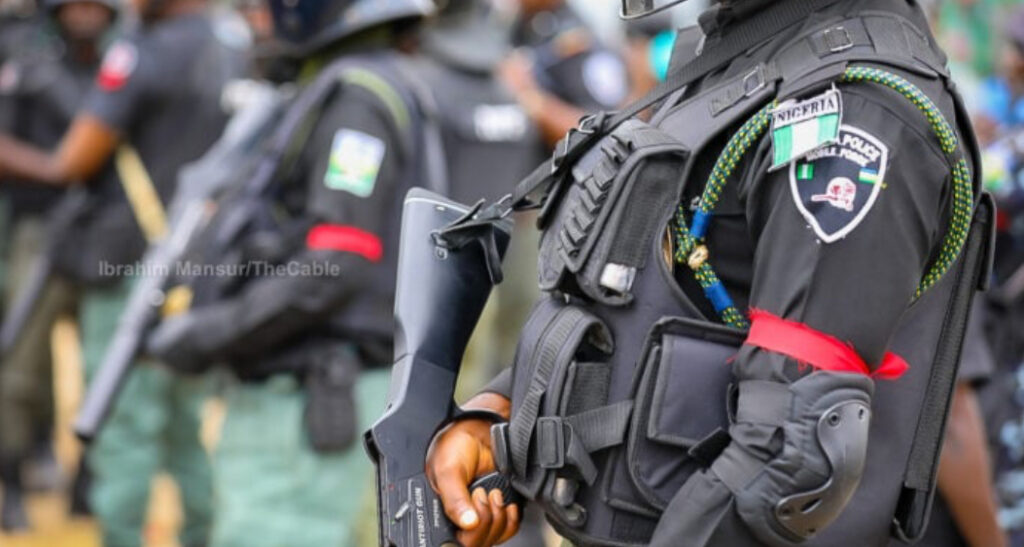
The Senate has indicated its readiness to accelerate the amendment of the 1999 Constitution to pave the way for the creation of state police, following renewed pressure from President Bola Ahmed Tinubu for sweeping security reforms.
Speaking in a telephone interview, Chairman of the Senate Committee on Media and Public Affairs, Yemi Adaramodu, said the National Assembly is giving heightened attention to the President’s appeal. According to him, lawmakers had already reached near consensus on the proposal even before the President’s recent public call.
Adaramodu explained that broad-based support from the Nigeria Governors’ Forum, state Houses of Assembly and traditional institutions has strengthened momentum for the reform. He noted that delays in the wider constitutional review were largely due to urgent work on amendments to the Electoral Act, which demanded concentrated legislative effort.
Now that the Electoral Act amendment has been concluded, the National Assembly, he said, is prepared to give the constitution review accelerated consideration.
President Tinubu formally urged lawmakers to commence the amendment process during an interfaith Iftar with senators at the Presidential Villa, Abuja. He described Nigeria as severely challenged by terrorism, banditry and insurgency, stressing the need for state police to improve local security, reclaim forests from criminal elements and restore public confidence.
The President reaffirmed his administration’s commitment to fulfilling campaign promises, declaring that security remains the bedrock of national prosperity. He argued that empowering states with policing authority is a practical solution rather than a political manoeuvre.
The renewed alignment between the executive and legislature appears to have revived a long-standing debate that has stalled for decades over fears of political abuse and constitutional complications.
Supporters argue that decentralised policing is essential in a country as large and diverse as Nigeria. Senator Sani Musa (Niger East) maintained that insecurity affects all 36 states and that state police would enhance response capacity.
However, opposition voices persist. Former Senate Leader, Mohammed Ali Ndume (Borno South), questioned the timing of the proposal, arguing that the federal government should first expand, train, equip and properly fund existing security agencies before creating new structures.
Civil society perspectives remain divided. Dr. Salaudeen Hashim of CLEEN Foundation warned that without careful safeguards, state police could deepen ethnic and religious tensions. He also raised concerns about funding capacity and the need for complementary institutions such as state correctional services and criminal justice systems.
UK-based commentator Sola Adeyemi contended that Nigeria’s current policing framework is overstretched and poorly adapted to local realities. He advocated a layered system comprising a lean federal police focused on terrorism and interstate crime, alongside locally accountable state forces and community units, backed by strong oversight mechanisms.
Professor Freedom Onuoha of the University of Nigeria, Nsukka, argued that Nigeria already operates quasi-state policing through vigilante outfits and regional security networks such as Amotekun. He suggested that the debate should shift from whether to adopt state police to how to legally formalise and regulate existing structures within a federal framework.
Elder statesman Chief Chekwas Okorie welcomed the President’s initiative, asserting that Nigeria’s centralised security architecture has proven inadequate for the country’s size and complexity. He expressed confidence that the National Assembly would swiftly pass any executive bill amending the constitution.
South-West socio-political groups, including Afenifere led by Chief Reuben Fasoranti and the Yoruba Leaders of Thought under Prince Tajudeen Olusi, also endorsed decentralised policing. Their representatives stressed that constitutional amendment—requiring approval by two-thirds of the National Assembly and ratification by at least 24 state assemblies—remains the key pathway.
Across the states, momentum appears to be building. Lawmakers in Plateau, Sokoto, Borno, Kano, Kaduna, Zamfara, Nasarawa and Gombe have either expressed readiness to debate or pledged to support the reform once it reaches them.
Under Nigeria’s constitutional framework, establishing state police demands a two-thirds majority in both chambers of the National Assembly and ratification by no fewer than 24 of the 36 state Houses of Assembly.
With executive backing intensifying and legislative consensus growing, the coming weeks could prove decisive. Should the amendment secure the required approvals, Nigeria may be on course for one of its most far-reaching security reforms since the return to democratic rule in 1999.