
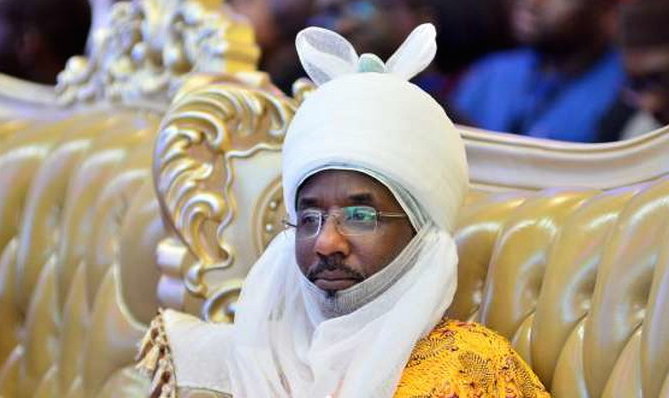
The 16th Emir of Kano, Muhammadu Sanusi II, has emphasised the importance of education in leadership, stating that traditional authority without knowledge holds little value.
Speaking during the Hawan Nasarawa Durbar at the Government House in Kano as part of the Eid al-Fitr celebrations, Sanusi clarified that his decision to pursue a law degree was not driven by court-related issues but by a desire to inspire others.
He urged critics to understand that education should come before kingship, noting that learning enhances both leadership capacity and societal respect.
Sanusi also expressed appreciation to the Kano State Government for the recognition and honour extended to the emirate.
Highlighting the role of education in traditional institutions, he stated that a well-educated monarch commands greater dignity, while one without education diminishes the value of the throne.
Meanwhile, Kano witnessed an unusual development during the Eid celebrations, as three separate prayers were held across the city, reflecting ongoing divisions among traditional and political leaders.
Sanusi led prayers at the Kofar Mata Eid Ground, attended by key officials including Governor Abba Yusuf and other top government figures. His sermon focused on unity and peaceful coexistence.
At the same time, the 15th Emir of Kano, Aminu Ado Bayero, held a separate prayer at the Nasarawa Palace, with messages centred on peace and stability.
In a parallel gathering, Rabiu Kwankwaso, leader of the Kwankwasiyya Movement, conducted his own Eid prayer at his residence, alongside loyalists and associates.
The multiple prayer sessions highlight the lingering emirate crisis in Kano, which began with Sanusi’s removal in 2020 and was further complicated by his reinstatement in 2024, leading to the existence of parallel royal authorities.
Political shifts, including Governor Yusuf’s reported move from the NNPP to the APC, have also contributed to the ongoing division. Historically, Eid prayers in Kano were observed as a single, unified event bringing together traditional rulers, political leaders, and residents.