
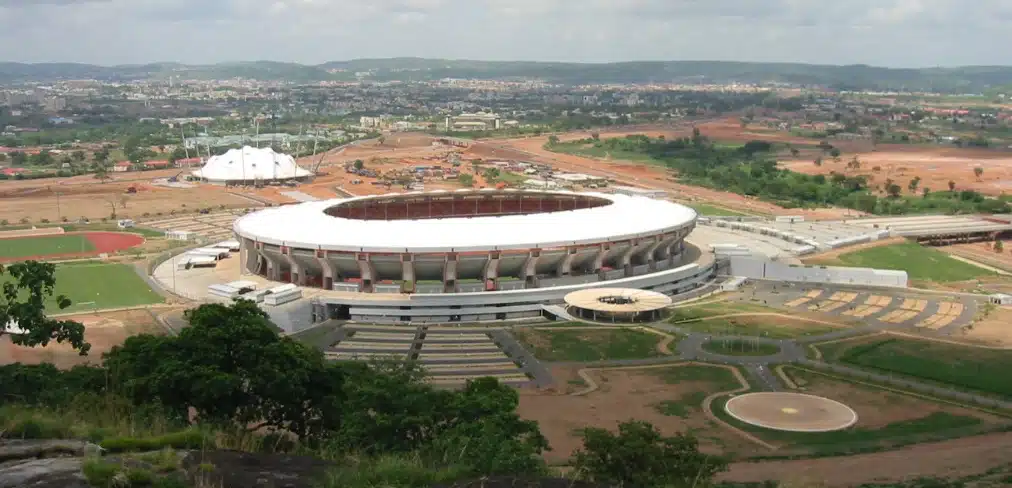
The Federal Government has outlined plans to rehabilitate the Moshood Abiola National Stadium in Abuja, with a proposed expenditure of ₦24.642 billion under the 2026 Appropriation Bill.
The amount forms part of the ₦203.6 billion budget allocated to the National Sports Commission (NSC), reflecting the government’s renewed effort to revive Nigeria’s deteriorating sports infrastructure.
President Bola Tinubu presented a ₦58.18 trillion “Budget of Restoration” to the National Assembly in December 2025, in which the sports sector recorded a significant boost. Funding for sports in the 2026 fiscal year rose by more than 300 per cent compared to the ₦78 billion approved in 2025.
Earlier, NSC Chairman Shehu Dikko revealed that rehabilitation work on the national stadium was expected to begin before the end of 2025, as part of a broader strategy to restore sporting facilities across the country to international standards.
Commissioned in 2003 during the administration of former President Olusegun Obasanjo, the Moshood Abiola National Stadium has in recent years been deemed unfit to host the Super Eagles and other major international events, despite undergoing renovation between 2020 and 2022 under former Sports Minister Sunday Dare.
Failed Renovation Efforts
As part of the last refurbishment, Africa’s richest man, Aliko Dangote, donated $1 million towards upgrading the stadium’s main bowl. The project, handled by local contractors, included the installation of Pure Dynasty Paspalum grass, digital scoreboards, sprinklers, nursery beds and a two-year maintenance plan through a Public-Private Partnership.
However, the upgrades failed to endure, with the pitch deteriorating less than a year after completion. This forced the Super Eagles to relocate home matches to the Godswill Akpabio International Stadium in Uyo, Akwa Ibom State.
Nigeria last played at the Abuja stadium on March 24, 2023, suffering a 1–0 loss to Guinea-Bissau in a 2023 AFCON qualifier. The condition of the pitch drew sharp criticism from former coach José Peseiro and several players.
Breakdown of Proposed Spending
Under the 2026 budget proposal, the NSC earmarked ₦18.775 billion for the first phase of rehabilitating and upgrading the stadium’s main bowl. An additional ₦5.8 billion was allocated to complete a high-performance centre for athletes, while ₦65 million was set aside for internet bandwidth, fibre-optic connectivity and LAN/WAN services at the stadium and other key sports facilities.
The budget also includes ₦15.5 billion for the construction of a new sports secretariat within the stadium complex.
Built between 2000 and 2003 at a cost of $360 million for the 8th All Africa Games, the Moshood Abiola National Stadium has a seating capacity of 60,491. Despite years of neglect and underuse, it remains Nigeria’s largest sporting arena.
Funding for International Competitions
Beyond infrastructure, the NSC also made provisions for Nigeria’s participation in major international sporting events. The Commission allocated ₦4.22 billion for the 2026 Commonwealth Games in Glasgow, Scotland, scheduled for July 23 to August 2.
Preparations for the 2028 Olympic Games in Los Angeles are projected to cost ₦5.11 billion, while participation in the 2026 Winter Olympics in Italy is estimated at ₦1 billion.
In football, Nigeria’s participation in the recently concluded 2025 AFCON, the forthcoming 2026 Women’s Africa Cup of Nations and other FIFA competitions involving both the men’s and women’s national teams is expected to cost ₦14.2 billion.