
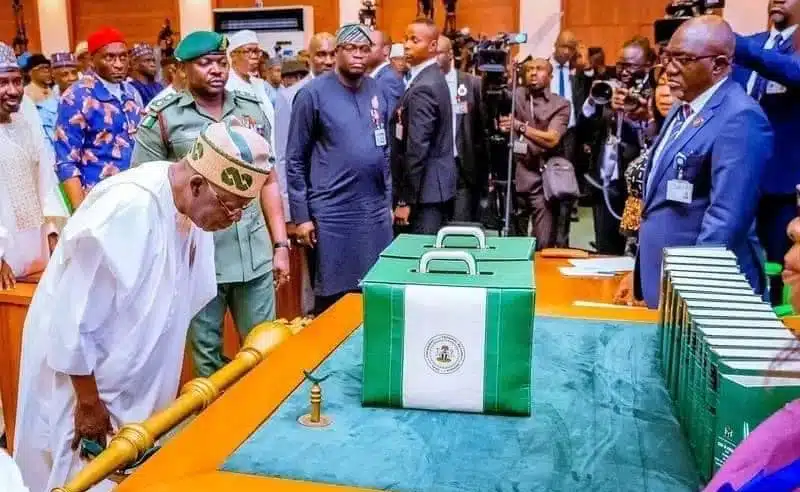
The House of Representatives on Thursday commenced debate on President Bola Ahmed Tinubu’s 2026 Appropriation Bill, approving the proposed ₦58.18 trillion budget for second reading. The budget is built around macroeconomic stability, improved security, and increased capital spending.
Tagged “The Budget of Consolidation, Renewed Resilience and Shared Prosperity,” the 2026 fiscal plan was presented to the National Assembly on December 19, 2025, and was described by lawmakers as a major step in Nigeria’s economic restructuring.
Leading the debate on the general principles of the bill, House Leader Rep. Julius Ihonvbere said the Tinubu administration inherited weakened institutions and noted that while reforms would be challenging, they were unavoidable.
“Development that is not sustainable is not development at all,” Ihonvbere told lawmakers, urging Nigerians to understand the need for difficult but necessary economic adjustments to secure long-term growth.
He cited projected economic growth of 3.98 percent in 2026, a decline in inflation to 14.45 percent from about 25 percent, rising government revenue, export growth, and increased foreign direct investment as reasons for supporting the budget.
Ihonvbere also pointed to improvements in the naira and external reserves, saying the currency has stabilised around ₦1,400 to the dollar, down from over ₦1,800, while foreign reserves have risen to about $47 billion — a seven-year high capable of covering more than 10 months of imports.
He added that the administration has not resorted to printing money since assuming office, describing this fiscal discipline as key to stabilising the economy.
The 2026 budget projects total revenue of ₦34.33 trillion against total expenditure of ₦58.18 trillion, leaving a deficit of ₦23.85 trillion. Non-debt recurrent spending is estimated at ₦15.25 trillion, while capital expenditure stands at ₦26.08 trillion — a structure lawmakers said signals a shift toward development-focused spending.
“This marks a clear departure from previous budgets where recurrent expenditure dominated. Capital investment now takes priority, which is essential for real development,” Ihonvbere said.
The budget assumptions include an oil benchmark of $64.85 per barrel and daily oil production of 1.84 million barrels. Key sectoral allocations include ₦5.41 trillion for security and defence, ₦3.56 trillion for infrastructure, ₦3.54 trillion for education, and ₦2.48 trillion for health.
Lawmakers also referenced the administration’s ongoing international engagements, including recent diplomatic and economic missions to countries such as Türkiye, aimed at improving Nigeria’s investment climate.
They stressed that the budget represents more than figures, highlighting commitments to fiscal discipline, improved revenue through tax reforms, reduced leakages, macroeconomic stability, and human capital development.
After deliberations, the Speaker put the bill to a voice vote, with lawmakers overwhelmingly approving it for second reading. The House then adjourned plenary for two weeks to allow for the budget defence.