
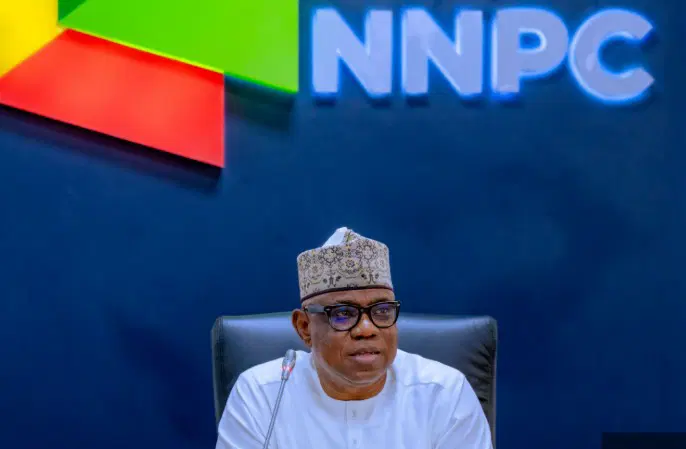
The Group Chief Executive Officer of the Nigerian National Petroleum Company Limited (NNPCL), Bayo Ojulari, has disclosed that Nigeria’s state-owned refineries were operating at what he described as a monumental loss, prompting his management team to suspend operations to prevent further financial damage.
Ojulari made the revelation on Wednesday in Abuja during a fireside chat titled “Securing Nigeria’s Energy Future” at the Nigeria International Energy Summit 2026, where he offered a blunt assessment of the operational and commercial realities facing the country’s refining assets.
Acknowledging public frustration, the NNPC boss said Nigerians were justified in their anger, given the enormous sums invested in the refineries over the years.
“On the refineries, Nigerians were angry. A lot of money has been spent, and expectations were very high. So we were under extreme pressure,” he said.
Naija News reports that Nigeria’s four state-owned refineries — Port Harcourt (two plants), Warri and Kaduna — have consumed billions of dollars in rehabilitation and turnaround maintenance over several decades, yet have failed to achieve sustained production.
‘I Had to Learn Very Fast’
Ojulari admitted that refining was not his area of specialization when he took office, having spent most of his career in the upstream sector.
“My background is upstream, so I was on a very steep learning curve. But you are accountable, and you must learn quickly,” he said.
He explained that once his team settled in, accountability demanded an immediate and honest review of the refineries.
‘We Were Running at a Monumental Loss’
According to Ojulari, a detailed operational review quickly exposed the true financial state of the facilities.
“The first thing that became clear is that we were running at a monumental loss to Nigeria. We were just wasting money,” he stated.
He said NNPC was feeding crude oil into the refineries monthly, yet utilisation remained between 50 and 55 per cent, leading to significant value loss.
“We were spending heavily on operations and contractors, but at the end of the day, value was just leaking away,” he added.
More concerning, he said, was the lack of a realistic recovery plan.
“Sometimes you make losses during investments, but you can see a path to recovery. That path was not clear here,” he noted.
Decision to Halt Operations
Ojulari revealed that suspending refinery operations was one of the first major decisions taken by his administration.
“We decided to stop the refineries and conduct a quick reassessment. If things had lined up, we would have reopened and worked on them,” he said.
He explained that the shutdown was necessary to prevent further financial losses while evaluating the refineries’ viability.
The NNPC chief also disclosed that part of the losses resulted from the quality of products being produced, citing the Port Harcourt Refinery.
“The crude processed in Port Harcourt was yielding mid-grade products. When you compare the output value with the input cost, it was simply a waste,” he said.
Ojulari admitted that the decision was politically sensitive due to longstanding pressure to keep the refineries running to support local fuel supply.
“There was a lot of political pressure to keep the refineries producing. But after over 35 years of training to focus on commerciality and profitability, you can’t ignore the numbers,” he said.
For decades, Nigeria’s refineries have operated far below capacity — sometimes at single-digit utilisation or shut down completely — forcing the country to rely heavily on imported refined petroleum products.
Despite multiple rehabilitation contracts worth billions of dollars approved between 2015 and 2023, domestic refining output remained negligible, intensifying public scrutiny of NNPC’s performance.
Ojulari’s remarks mark one of the most candid acknowledgements by an NNPC chief executive that continued refinery operations, under existing conditions, were economically unsustainable, underscoring a shift toward stricter commercial discipline under the Petroleum Industry Act.