
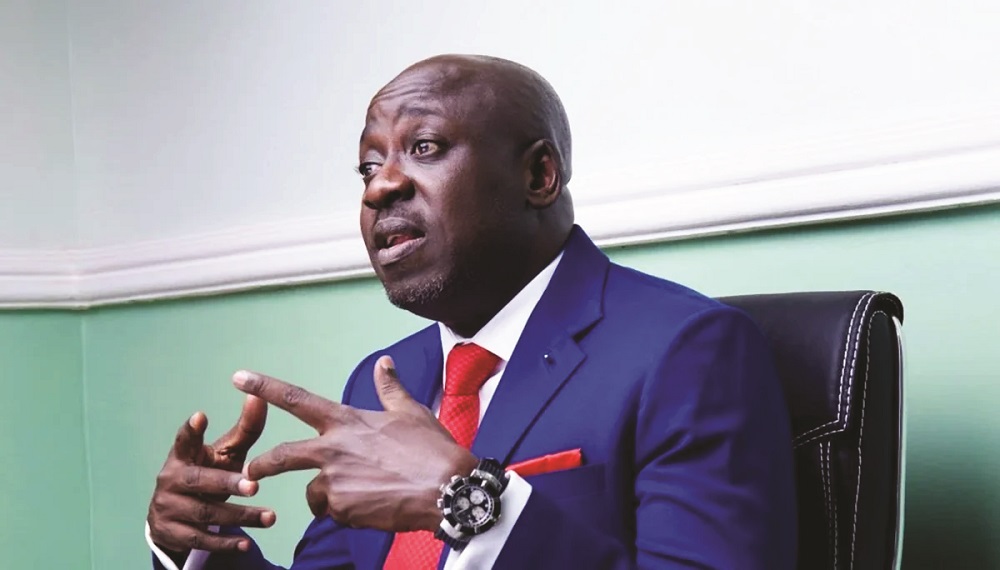
The Presidency has accused the African Democratic Congress (ADC) spokesperson, Bolaji Abdullahi, of deliberately misrepresenting the state of security in Nigeria.
Reacting to Abdullahi’s comments, the Special Assistant to President Bola Tinubu on Social Media, Dada Olusegun, asserted that President Tinubu has accomplished more in the security sector within two years than the Peoples Democratic Party (PDP)—under which Abdullahi once served as a minister—did throughout its 16 years in power.
Abdullahi had claimed in a post on his 𝕏 account on Saturday that the growing insecurity across parts of the country was evidence that Nigeria was without effective governance.
“The festering insecurity and violent attacks in Kwara, Katsina, and other parts of the country, and the massacre of innocent Nigerians, are concrete proof that Nigeria has no government,” he wrote.
In response, Olusegun described the statement as dishonest and accused the former minister of deploying “reverse psychology” to distort the facts.
He outlined several security initiatives implemented under the Tinubu administration, including increased defence spending, sustained military operations, efforts to fast-track the establishment of state police, and the recruitment of additional security personnel.
According to him, these measures are already producing results, even though recent attacks in some areas remain deeply condemnable.
“While the recent attacks in parts of the country are totally condemnable, it is dishonest—though unsurprising coming from you—to compare the efforts of a president who has done more for the security sector in two years than your former party, the PDP, did in 16 years,” Olusegun stated.
He added that President Tinubu, building on the efforts of former President Muhammadu Buhari, who significantly weakened Boko Haram, has adopted proactive and innovative strategies to address insecurity—unlike what he described as the “dormant, uninspiring, and directionless” approach of the PDP years.
Olusegun listed several achievements of the Tinubu administration over the past two and a half years, including a rise in defence spending from ₦1.25 trillion in 2023 to ₦4.91 trillion in 2025, improved inter-agency coordination, and the disruption of major terrorist cells.
He said sustained military operations have led to the surrender of over 160,000 Boko Haram and ISWAP members and their families, while efforts to decentralise policing have seen multiple states adopt local security initiatives such as forest guards and mining marshals.
The presidential aide also noted the establishment of new army recruitment depots in Osogbo and Ebonyi to boost enlistment, as well as a comprehensive overhaul of the national security framework, including a new counterterrorism doctrine that designates all armed non-state actors as terrorists, as reflected in the 2026 budget.
Other initiatives cited include the creation of the Ministry of Livestock Development to address farmer-herder conflicts and the National Commission for Almajiri and Out-of-School Children Education to curb the recruitment of vulnerable youths into criminal networks.
On equipment upgrades, Olusegun said the Nigerian Air Force has acquired five additional aircraft—two Diamond 62 surveillance planes, two T-129 ATAK helicopters, and a King Air 360 ER—enabling over 8,600 missions and nearly 16,000 flying hours.
He added that between August 2023 and April 2025, security forces neutralised over 9,400 terrorists, arrested more than 3,100 suspects, and rescued 5,449 hostages.
“These efforts have also weakened the influence of groups such as IPOB and contributed to improved community trust and broader social stability,” he said.
Olusegun concluded that Nigerians who experienced both administrations would not be misled by what he described as attempts at historical revisionism.
“They see the effort, they understand the process, and they feel the seriousness. The same cannot be said of the administration you are trying to whitewash. We will not stand by while facts are twisted. We will not,” he said.