
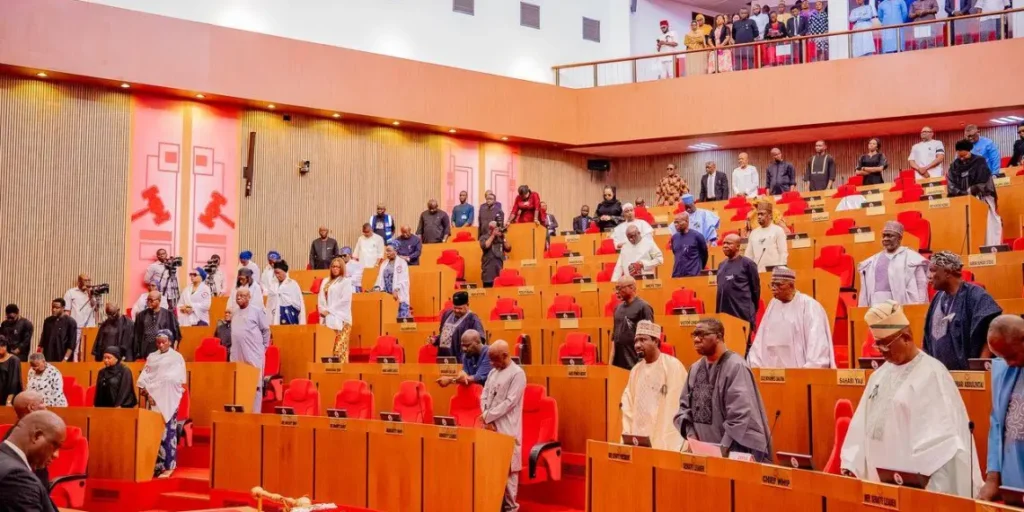
The Senate on Tuesday held an emergency plenary session to deliberate on the contentious amendments to the Electoral Act, following widespread protests sparked by the removal of a provision mandating real-time electronic transmission of election results.
The extraordinary sitting came only days after the passage of the Electoral Act Amendment Bill, 2026, and amid growing backlash from civil society organisations, labour unions, opposition parties, professional bodies and youth groups, who have accused the National Assembly of weakening electoral transparency.
Early on Tuesday, hundreds of protesters converged on the entrance of the National Assembly Complex in Abuja, singing solidarity songs and displaying placards calling for electoral accountability and the adoption of digital result transmission.
Although the protest remained peaceful, it prompted a heavy security presence, with police officers and paramilitary personnel deployed across major access points.
The emergency session was presided over by Senate President, Godswill Akpabio, and recorded full attendance by senators despite recent changes in the composition of the upper legislative chamber.
Proceedings, which began around noon, were largely dominated by deliberations on the Electoral Act amendment as public discontent continued to mount.
The Senate’s membership has recently dropped from 109 to 106 following the deaths of Senator Okechukwu Ezea (Enugu) and Senator Godiya Akwashiki (Nasarawa), as well as the nomination of Senator Jimoh Ibrahim as ambassador-designate by President Bola Tinubu.
The emergency plenary was formally announced on Sunday in a statement issued by the Clerk of the Senate, Emmanuel Odo, which stated: “The President of the Senate, Godswill Akpabio, has directed the reconvening of plenary for an emergency sitting on Tuesday, February 10, 2026.”
The session followed sustained public pressure urging the Senate to reverse its decision to delete the phrase “real-time” from the provision on electronic transmission of election results.