
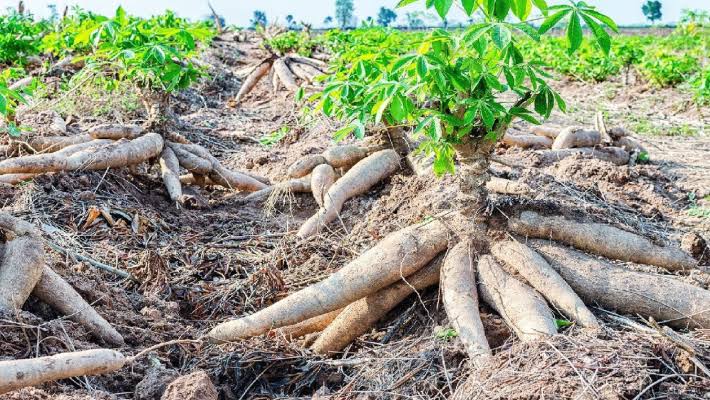
The Central and West African Virus Epidemiology for Root and Tuber Crops (WAVE) has launched an awareness campaign for cassava farmers in Kebbi State to help prevent the spread of a newly identified cassava mosaic virus that is advancing across parts of Africa.
According to the News Agency of Nigeria (NAN), the sensitisation exercise took place in Tungar Noma community, located in Argungu Local Government Area of the state.
The initiative aims to educate farmers on the dangers posed by the virus, its impact on cassava production, and the potential threat it poses to food security.
Speaking during the programme, the Country Director of WAVE, Prof. Ibrahim Umar, disclosed that the organisation, in partnership with Abdullahi Fodio University of Science and Technology, Aliero, has established six demonstration farms across the North-West and North-East regions.
He explained that the demonstration plots are intended to improve cassava yields and strengthen disease management practices among farmers.
Umar noted that while cassava mosaic disease already exists in Nigeria, several other cassava-related diseases found across Africa are gradually moving westward.
“We already have cassava mosaic disease in Nigeria, but there are about 11 other cassava diseases across Africa, particularly in East Africa, that are gradually spreading toward West Africa,” he said.
He identified the East African Cassava Mosaic Disease-Uganda variant as the most dangerous, warning that it can completely wipe out harvests and leave affected farmers with little or no yield.
“The disease is highly destructive because farmers may end up harvesting nothing from infected farms. Although it has been detected in some West African countries, it has not yet been reported in Nigeria,” Umar added.
He further explained that the awareness campaign is designed to involve farmers in monitoring and reporting any unusual symptoms observed on their cassava farms.
According to him, contact numbers and informational flyers containing images of disease symptoms have been distributed to farmers to enable quick reporting and prompt intervention.
“We have shared phone numbers and educational materials showing possible disease symptoms so farmers can easily identify and report suspicious signs for immediate action,” he said.
Umar stressed that Nigeria’s position as the world’s largest cassava producer makes the country particularly vulnerable to the virus, warning that an outbreak could have severe consequences for food production and the agricultural sector.