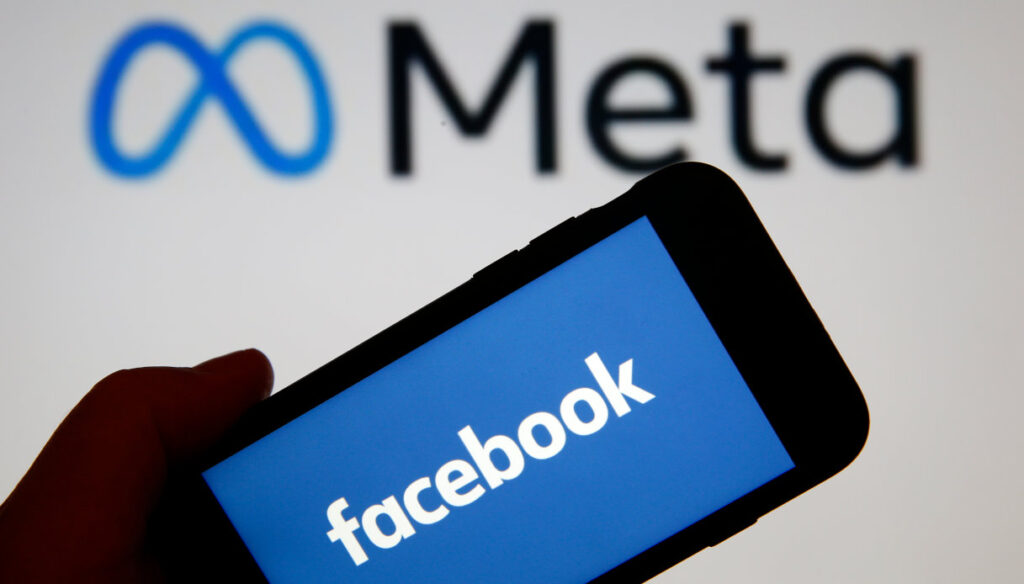
in front of a Meta logo on October 28, 2021 in Paris, France. This October 28, during the Facebook Connect virtual conference, Mark Zuckerberg announced the name change of Facebook, believing that the term Facebook was too closely linked to that of the platform of the same name, launched in 2004. It is now official, the Facebook company changes its name and becomes Meta. (Photo illustration by Chesnot/Getty Images)
A Federal High Court in Lagos has set aside the ₦60 billion sanction imposed by the Advertising Regulatory Council of Nigeria against Facebook Nigeria Operations Limited over alleged unapproved advertisements targeted at the Nigerian market.
The court ruled that ARCON exceeded its statutory authority and violated the company’s constitutional right to a fair hearing in imposing the penalty.
Delivering judgment in Suit No. FHC/L/CS/2205/2024, Justice Yellim Bogoro declared ARCON’s Notice of Violation/Demand for Compliance, dated October 21, 2024, unconstitutional, unlawful, null and void. The court also restrained the regulator from taking further steps to enforce the notice.
In the judgment delivered on June 18, 2026, the court held that ARCON lacks the legal authority to impose fines for alleged criminal breaches under the Advertising Regulatory Council of Nigeria Act, 2022, without first obtaining a conviction from a competent court or tribunal.
The dispute arose after ARCON accused Facebook Nigeria of displaying advertisements on Facebook and Instagram to Nigerian users without obtaining prior approval from the Advertising Standards Panel, contrary to provisions of the ARCON Act and the Nigerian Code of Advertising.
The regulator directed the company to stop displaying the advertisements and demanded payment of ₦60 billion for what it described as repeated regulatory violations.
Represented by Senior Advocate of Nigeria (SAN) Mofesomo Tayo-Oyetibo, Facebook Nigeria challenged the notice, arguing that ARCON lacked the legal authority to determine criminal liability or impose punitive sanctions through an administrative process without first giving the company an opportunity to defend itself.
The company also maintained that it neither owns nor operates Facebook or Instagram, stating that both platforms are owned and managed by Meta Platforms, a separate foreign corporate entity.
ARCON, represented by Senior Advocate of Nigeria (SAN) Akinlolu Kehinde, argued that Facebook Nigeria represents Meta’s operations within Nigeria and should therefore be held accountable for regulatory violations linked to advertisements displayed on the platforms.
The regulator further contended that its notice was a compliance directive, giving the company the option to comply, pay the prescribed violation fee, or face prosecution.
However, Justice Bogoro rejected ARCON’s arguments, ruling that Facebook Nigeria is a separate legal entity from Meta Platforms and that the regulator failed to provide sufficient evidence proving that the Nigerian company owns, controls, or operates Facebook or Instagram.
The court held that merely asserting Facebook Nigeria represents Meta’s interests in Nigeria was insufficient to establish liability for the alleged advertising breaches.
On the issue of fair hearing, the judge ruled that ARCON violated Section 36 of the Constitution by making allegations and simultaneously imposing a substantial financial penalty without first allowing the company to respond.
Justice Bogoro further noted that Section 57(4) of the ARCON Act expressly requires the regulator to grant an alleged violator a fair hearing before imposing any sanction.
The court also held that the alleged offences cited by ARCON are criminal in nature under Section 34 of the ARCON Act, which provides that punishment can only follow a valid conviction by a court of competent jurisdiction.
Accordingly, the judge ruled that the ₦60 billion demand was effectively a criminal fine that ARCON had no authority to impose through an administrative process.
The court consequently nullified the Notice of Violation/Demand for Compliance, declared it ultra vires ARCON’s statutory powers, and issued a perpetual injunction restraining the regulator, its officers, agents, and representatives from enforcing the October 21, 2024 notice against Facebook Nigeria.
The ruling is expected to shape the future of digital advertising regulation in Nigeria by reaffirming the limits of regulatory enforcement powers and emphasizing that criminal penalties can only be imposed through due judicial process.