
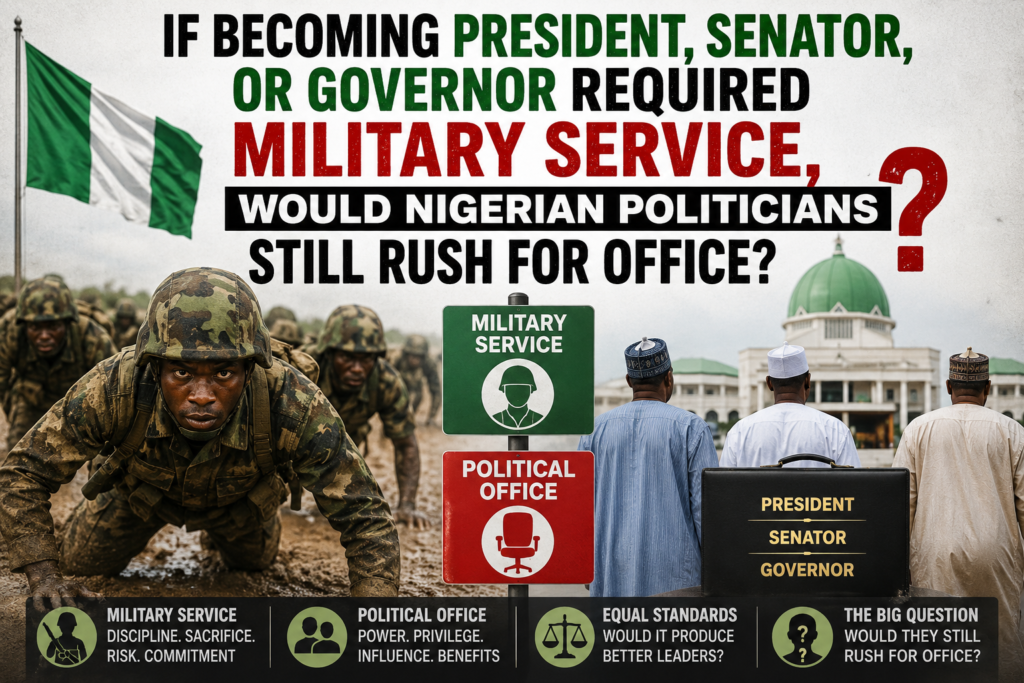
Lagos, Nigeria — A growing debate among Nigerians has raised a thought-provoking question: would the scramble for political offices remain as intense if aspiring presidents, governors, senators, and lawmakers were required to undergo the same rigorous training, discipline, and risks faced by members of the Nigerian Armed Forces?
The question, which has gained traction on social media and in public discourse, comes amid increasing concerns about the motivations behind political ambition in the country. While thousands of young Nigerians compete annually for limited slots in the military despite the physical challenges and dangers involved, political positions continue to attract fierce competition due to the prestige, influence, and benefits attached to public office.,
Analysts argue that military service demands sacrifice, commitment, and a willingness to place national interest above personal comfort. Recruits undergo months of intensive training and may eventually be deployed to conflict zones where they face significant risks in the line of duty.
In contrast, critics of Nigeria’s political system say elected offices have increasingly become attractive because of the financial rewards, security privileges, and social status associated with them.
According to political commentator Ibrahim Suleiman, introducing service-oriented requirements for public office could fundamentally change the nature of political participation.
“If politicians were required to endure the same level of sacrifice expected from soldiers before seeking office, we might witness a different caliber of leadership. Those driven purely by personal gain could reconsider their ambitions,” he said.
Supporters of this viewpoint believe leadership should be built on service rather than privilege. They argue that politicians should experience firsthand the realities faced by ordinary citizens and security personnel before assuming positions of authority.
However, constitutional experts caution against comparing military service directly with democratic leadership. They note that democracy is designed to allow citizens from diverse professional backgrounds to participate in governance.
“Political leadership and military service are different forms of national service,” legal analyst Grace Eze explained. “The military protects the nation through security operations, while elected officials are expected to provide policy direction and governance.”
Nevertheless, many Nigerians insist that the current political structure often appears to reward office holders more than it demands accountability from them. Some have suggested reforms such as mandatory public service records, stricter performance evaluations, and reductions in the cost of governance.
On social media, citizens expressed mixed reactions. While some argued that political offices would attract fewer candidates if they carried risks similar to military service, others maintained that genuine leaders would still step forward regardless of the challenges involved.
For many observers, the debate is less about forcing politicians into military-style service and more about redefining public office as a position of sacrifice rather than entitlement.
As Nigeria continues to grapple with economic challenges, insecurity, and governance concerns, the discussion has reignited calls for leaders who view public office not as a pathway to privilege, but as a commitment to serving the nation.
Whether such reforms would reduce political competition remains uncertain. What is clear, however, is that many Nigerians are increasingly demanding a system where leadership is earned through service, accountability, and dedication to the public good.