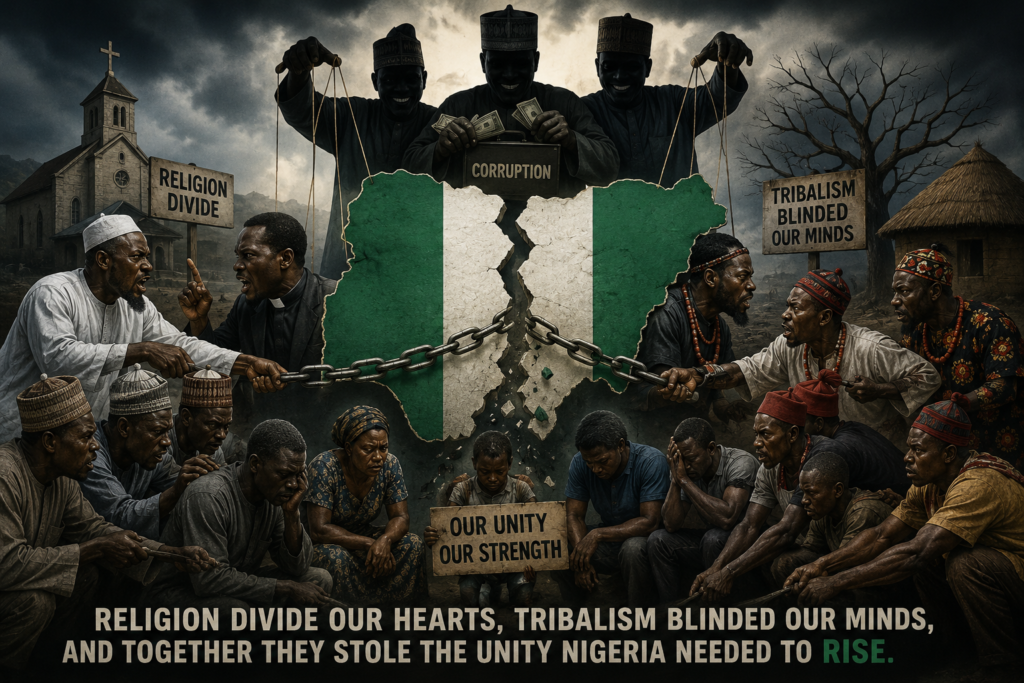

How religion and tribalism fractured a nation blessed with promise
Nigeria — Decades after independence, many citizens believe the country’s deepest wounds were not caused by a lack of resources, but by the divisions that slowly poisoned national unity.
“Religion divided our hearts, tribalism blinded our minds, and together they stole the unity Nigeria needed to rise.”
Those words have resurfaced across conversations, political debates, and social commentary as frustration grows over insecurity, corruption, ethnic tension, and economic hardship in Africa’s most populous nation.
Despite enormous oil wealth, cultural diversity, and human talent, Nigeria has struggled to build a united national identity. Analysts say ethnic loyalty and religious sentiment have repeatedly overshadowed competence, justice, and patriotism.
From election campaigns to government appointments, tribal and religious affiliations often shape public opinion more strongly than policy or performance. Political observers argue that this pattern has deepened mistrust among citizens and weakened national development.
Across the country, many Nigerians say they were taught to see one another first as Hausa, Igbo, Yoruba, Christian, or Muslim — before simply seeing themselves as Nigerians.
Historians note that ethnic rivalry intensified after independence and became even more dangerous during the Nigerian Civil War between 1967 and 1970, a conflict that left lasting scars on national unity. Nigerian Civil War
Religious tensions have also fueled violence in several regions over the years, claiming thousands of lives and displacing communities. In many cases, political actors have been accused of exploiting faith and ethnicity to gain power, influence elections, and silence opposition.
Yet amid the divisions, many citizens continue to call for a rebirth of national consciousness.
Youth groups, civic organizations, and social commentators have increasingly urged Nigerians to reject tribal hatred and religious intolerance, arguing that unity remains the country’s only path toward stability and progress.
“We cannot build a strong nation while constantly tearing each other apart,” said a university student in Lagos. “If we keep choosing tribe over truth and religion over reason, the future will keep slipping away.”
For many, the message is clear: Nigeria’s diversity was meant to be its strength — not the weapon used against itself.
As economic hardship and insecurity continue to test the nation, citizens are once again confronting an uncomfortable question:
What could Nigeria have become if unity had come before division?