
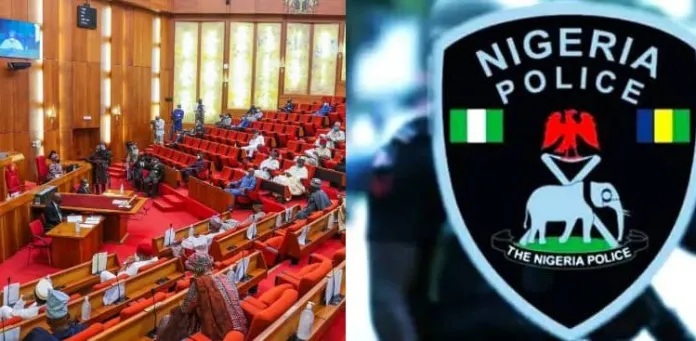
The Nigerian Senate on Tuesday passed for second reading a bill seeking to repeal the existing Nigeria Police Trust Fund Act of 2019 and introduce a new legal framework aimed at improving funding for the Nigeria Police Force.
The proposed legislation, titled the Nigeria Police Trust Fund Bill, 2026 (SB 1030), is designed to ensure sustainable financing for police equipment, training, and welfare, while creating a revised funding structure for the Force.
Debate on the bill sparked strong reactions among lawmakers, particularly over the constitutionality of funding the Trust Fund through deductions from the Federation Account.
Raising concerns, Ibrahim Dankwambo warned that the proposed 0.5 percent deduction could be challenged in court and potentially invalidated, noting that a similar arrangement had previously faced opposition from state governors and was struck down.
He also questioned how the proposed funding model would align with ongoing discussions about establishing state police.
Other lawmakers, including Buhari Abdulfatai, argued that the primary challenge facing the police is not just funding levels but the lack of adequate equipment and operational support. He pointed out that Nigeria has roughly 300,000 police officers serving a population exceeding 200 million.
The President of the Senate, Godswill Akpabio, emphasised that while there is general agreement on the need to strengthen police funding, adherence to constitutional provisions remains critical.
“We are lawmakers; we must also respect the law. The Constitution of Nigeria remains supreme,” he stated.
Akpabio urged lawmakers to examine whether the bill complies with Sections 80 and 81 of the Constitution, which govern withdrawals from the Consolidated Revenue Fund.
In response, Mohammed Tahir Monguno cited Section 80(2), arguing that the National Assembly has the authority to legislate expenditures charged to the fund. However, Akpabio maintained that Section 81 requires such expenditures to be included in annual budget estimates rather than implemented as direct statutory deductions.
After deliberations, the Senate President called for a voice vote, with the majority supporting the bill, allowing it to pass second reading.
He noted that a public hearing would address outstanding concerns, including accountability for previous Trust Fund spending, alternative funding sources, and how the framework would accommodate potential state policing structures.
Akpabio also directed the Senate Committee on Police Affairs to provide a briefing on how past Trust Fund allocations were utilised.
The bill has now been referred to the Senate Committee on Police Affairs, which is expected to report back within two weeks.