
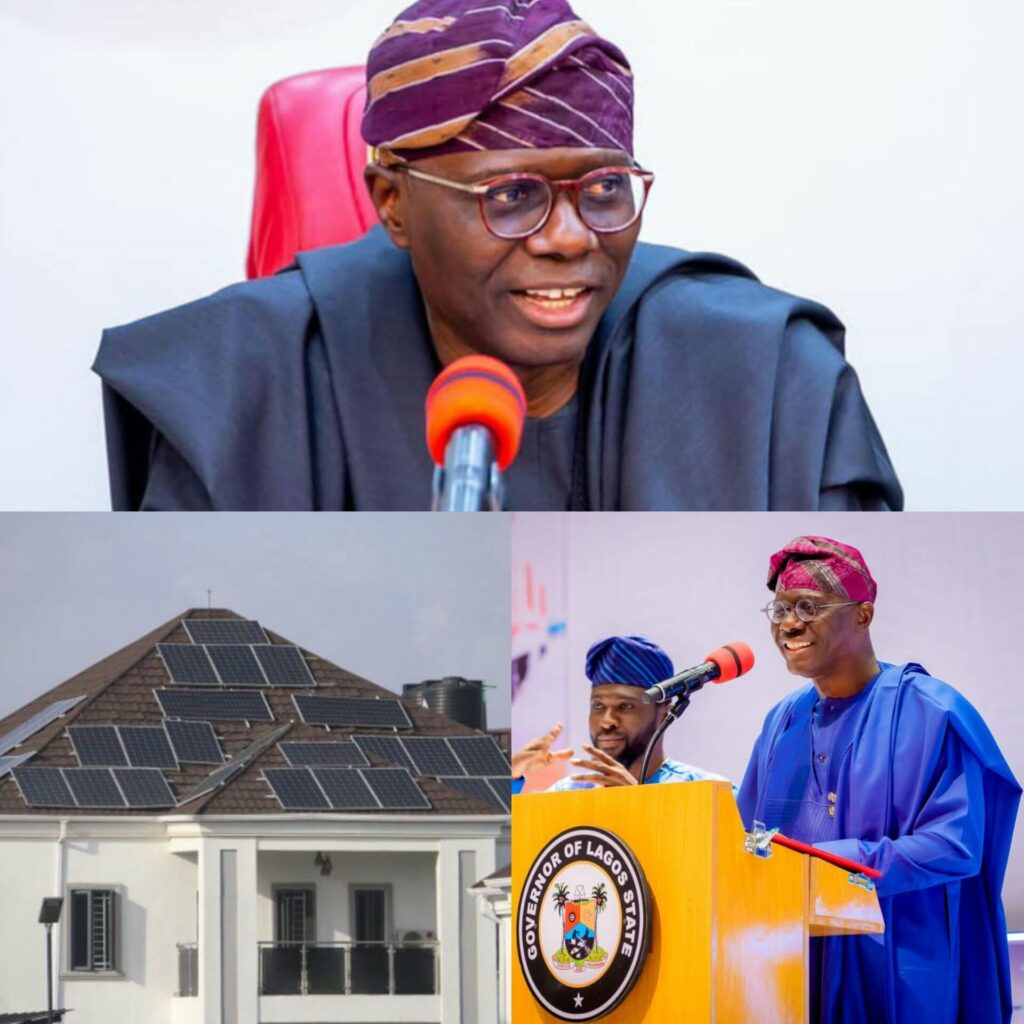
The Lagos State Government has i$$ued a clarification on its policy regarding solar panel installations, following widespread reactions to a viral video that suggested residents must pay fees before adopting solar energy.
The clarification was provided by Wale Ajetunmobi, Senior Special Assistant on Media to Governor Babajide Sanwo-Olu. According to him, the requirement applies only to residents living in government-owned social housing estates.
Ajetunmobi explained that installing solar panels in such estates is considered an external modification to the building structure.
As a result, residents—referred to as allottees—must obtain approval from the Ministry of Housing, particularly its Phys!cal Planning and Survey departments, to ensure safety and protect shared infra$tructure.
“This development is true, but the man who made the video seems to be misinformed about the Lagos State Government’s guidelines,” he said, noting that the policy is not new.
The controversy began after a video surfaced showing enforcement officials from the Ministry of Housing’s Monitoring and Compliance Unit requesting documentation and administrative fees from a resident within a state-owned estate. The footage tr!ggered public concern, with many interpreting it as a br⁰ader att£mpt to impose a “solar tax” across the state.
However, officials stressed that the rule is limited str!ctly to public housing sch£mes managed by the government, including estates under agencies like the Lagos State Development and Property Corporation.
Further clarification from the Ministry of Housing, through Permanent Secretary Abdulhafis Toriola, reaffirmed that approval is required for any structural changes in these estates. This includes solar installations, which could aff£ct shared facilities such as rooftops, electrical systems, and walls in multi-unit buildings.
Authorities emphasized that enforcement actions are targeted at ensuring compliance within planned residential environments, where unregulated modifications could pose r*sks such as f!re haz+ards or structural dam@ge.
Importantly, the government stated that private homeowners and residents in non-government estates are not subject to these fees or approval requirements for installing solar systems, although standard safety regulations still apply.
The clarification aims to ease public concerns while reinforcing the need for regulatory oversight in state-managed housing, especially as more Nigerians turn to alternative energy solutions amid ongoing el£ctricity chall£nges.