
The Director General of Morocco’s National Office of Hydrocarbons and Mines, Amina Benkhadra, has revealed that an intergovernmental agreement for the proposed $25 billion Nigeria-Morocco gas pipeline will be signed before the end of 2026.
Speaking in a report by Reuters, Benkhadra highlighted renewed progress on the major energy project, noting that a dedicated pipeline authority would be created in Nigeria after the agreement is finalized.
According to her, the authority will include ministerial representatives from the 13 participating countries to provide oversight and ensure smooth coordination.
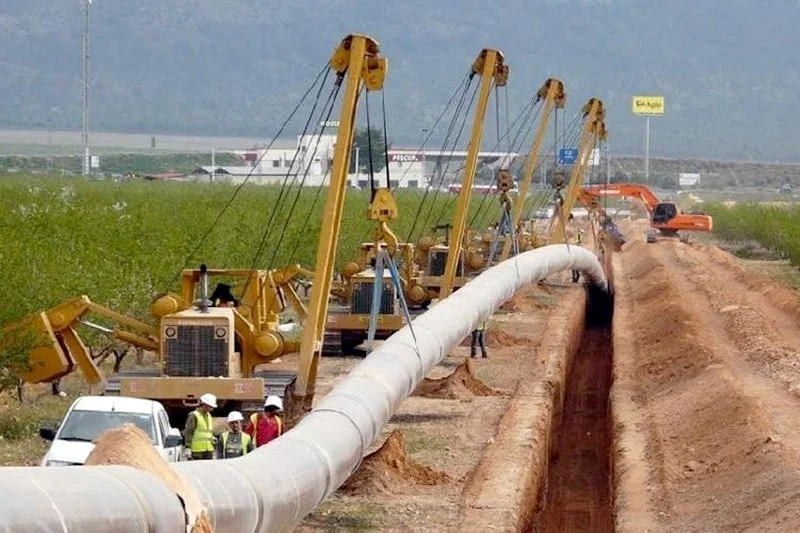
The Nigeria-Morocco gas pipeline, also known as the African Atlantic Gas Pipeline, is a 6,900-kilometre project combining offshore and onshore infrastructure. It is expected to deliver up to 30 billion cubic metres of gas annually, with about half allocated to Morocco and exports to Europe.
The project has received support from the Economic Community of West African States (ECOWAS), with feasibility studies and front-end engineering design already completed.
Benkhadra disclosed that Morocco’s ONHYM and the Nigerian National Petroleum Company will form a joint venture based in Morocco to oversee financing, construction, and execution.
She added that beyond supplying gas, the pipeline is expected to boost regional integration, support power generation, encourage industrial growth, and strengthen the mining sector across participating countries.
The project is also seen as positioning Morocco as a key energy link between Africa and Europe. Initial phases will connect Morocco to gas reserves in Mauritania and Senegal, while also linking Ghana to Côte d’Ivoire, before extending to Nigeria’s gas network.
First Gas by 2031
Benkhadra stated that gas from the early phases is expected to begin flowing by 2031, with each segment of the pipeline to be developed independently to accelerate delivery.
She noted that funding will come from a mix of equity and debt, although final financial commitments are yet to be secured. However, she added that the project is attracting strong global interest due to its scale and strategic importance.
In October 2022, Nigeria, Morocco, Senegal, and Mauritania signed a memorandum of understanding for the pipeline.
Meanwhile, the Federal Government is also advancing talks on the $20 billion Trans-Sahara Gas Pipeline, a 4,128-kilometre նախագ project designed to transport up to 30 billion cubic metres of gas annually from Nigeria through Niger and Algeria to Europe.
Both initiatives are considered vital to expanding Nigeria’s gas export capacity and strengthening its energy partnership with European markets.